01 · Hull
Hull crackle
Does the pericarp shatter clean, or cling as tooth-paper? Integrity in life; grace in death.
Journal · Physics of the flake
A kernel is a tiny pressure vessel. Moisture turns to steam, the pericarp holds, starch softens — then the hull fails and the endosperm blooms into foam. Method changes how heat arrives. The physics stay the same.
Figures are published ranges, not kitchen absolutes. See footnotes.1–3
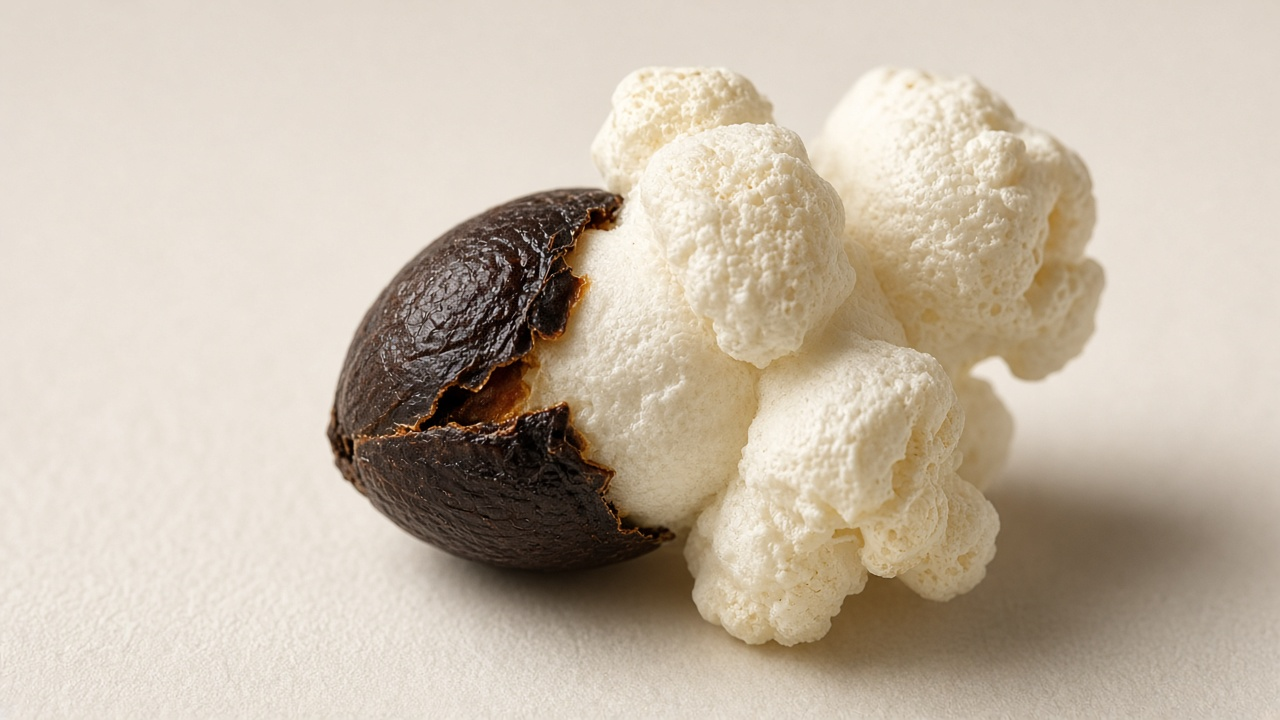
01 · Anatomy
Hover or tap a layer. The pericarp is the pressure wall. The endosperm holds the starch and the water that will become steam. The germ is the living seed — flavorful, oily, not the engine of the pop.
02 · Interactive
Switch the method. Heat path, timing, moisture loss, and what you taste all change — the rupture still arrives near nine atmospheres.
Readouts are stylized curves keyed to published ranges — useful for comparing methods, not for calibrating your stove.
What you taste
—
Schematic demo time
Schematic curves (Hoseney / Gökmen / Virot ranges) · Pressure = thick · Temperature = thin · Drag scrubber to pause and scrub the stage.
03 · Selection
Zea mays everta earned the job: a hard, moisture-tight pericarp and dense translucent endosperm. Dent and sweet corn fail the pressure test. Within popcorn, moisture and hull integrity decide who blooms and who stays an old maid.
Expansion volume peaks near 14% moisture by weight. Too dry and pressure never builds. Too wet and you get chew, poor expansion, or mold in storage. The hull band below is the published sweet spot — not a marketing gradient.
Best popping often reported around 13.5–14.5%; usable band roughly 11–15.5% depending on hybrid and method.2
A cracked hull vents steam early. No pressure, no pop — “old maids” are usually a moisture or hull problem, not bad luck.
Translucent hard endosperm gelatinizes and foams. Soft, opaque starch leaves voids without the same expansion.
04 · Atlas method
Science explains the pop. The directory judges the flake. Four axes, scored in the open — Letterboxd discipline, Consumer Reports spine.
Does the pericarp shatter clean, or cling as tooth-paper? Integrity in life; grace in death.
Expansion volume you can see. Butterfly wings vs. mushroom density — method and hybrid both write this line.
Crisp edge, tender center, no rubber. Moisture window and heat path show up here first.
Carrier or coat? Enough to hold salt and aroma — never a greasy apology for weak corn.
Always our #1 listing. Small kernel, serious hull, bloom that earns the science above — not a mascot, a standard. Everything else on the atlas is measured in that light.